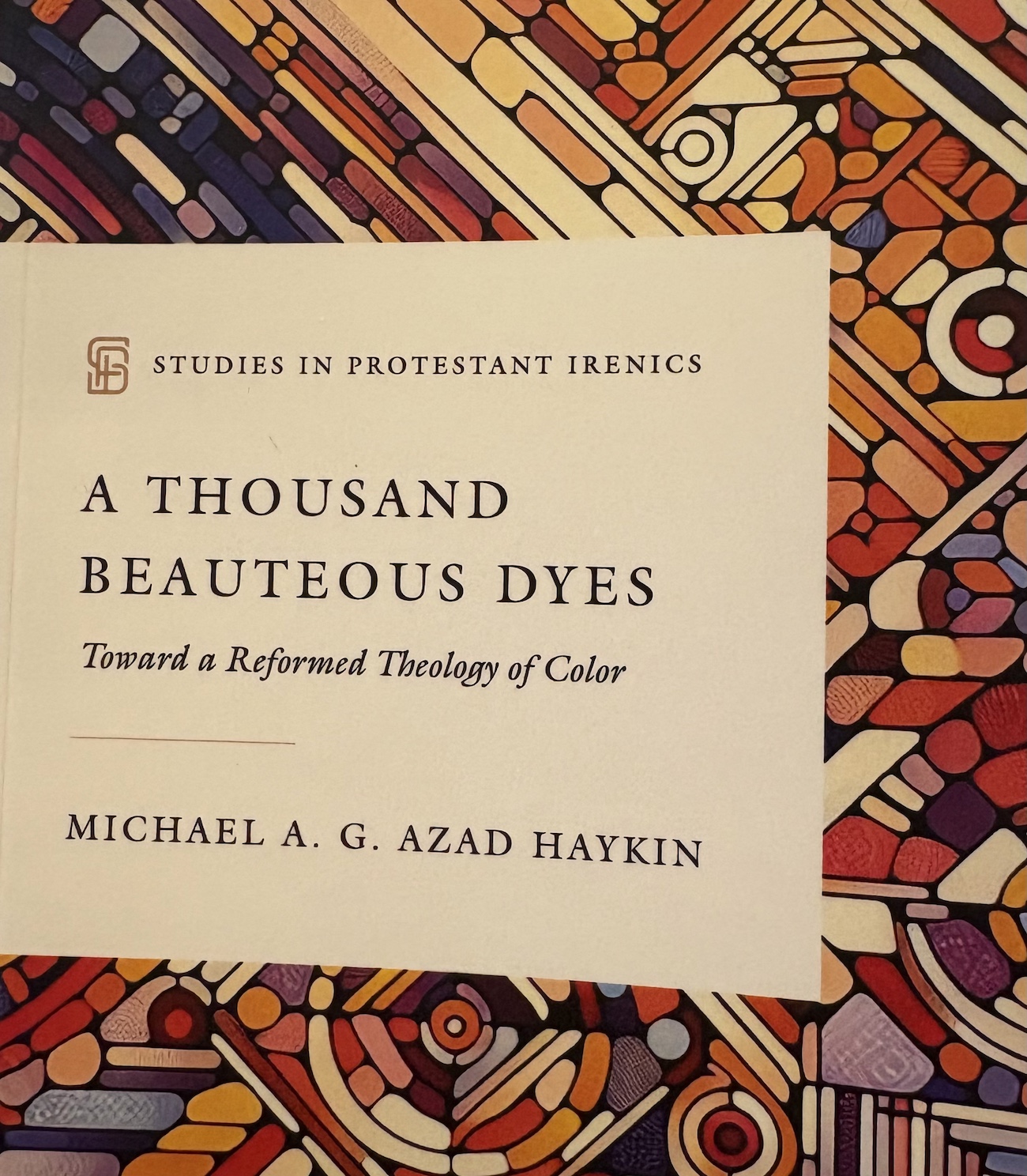
A Thousand Beauteous Dyes
Dr. Michael Haykin is one of the outstanding Canadians who grace the faculty of Southern Baptist Theological Seminary, others being Peter Gentry and Steve Wellum. It was a joy to be his colleague and to speak at one of his events in the Toronto area. I first met him when he spoke at Midwestern Baptist Theological Seminary, where I was serving. When he heard that my father had written his PhD dissertation at the University of Edinburgh on the life and work of Abraham Booth, Michael asked to see a copy along with his notes and ended up facilitating its publication, whose foreword he supplied. (Raymond Arthur Coppenger, A Messenger of Grace: A Study of the Life and Thought of Abraham Booth) My order of 75 copies arrived just in time for Dad to sign them for distribution to those attending his one hundredth birthday party in November of 2009.
In his book, god is not Great: How Religion Poisons Everything, the late Christopher Hitchens reports smugly on a teaching from his schoolboy days, one offered up by Mrs. Jean Watts: “So you see, children, how powerful and generous God is. He has made all the trees and grass to be green, which is exactly the color that is most restful to our eyes. Imagine if instead, the vegetation was all purple, or orange, how awful that would be.” He calls her a “pious old trout,” thus showing himself to be an “impious old blowfish.” Mrs. Watts was an easy target for this celebrated atheist. Not so much Hugh of St. Victor, Jonathan Edwards, Matthew Henry, Philip Doddridge, Isaac Newton, and Isaac Watts, who, as Dr. Haykin demonstrates, saw green as a marvelous aspect of God’s creation.
Indeed, A Thousand Beauteous Dyes marshals the writings of scores of greats from church history and our cultural heritage to both celebrate the Lord’s gracious palette and to show its interplay with Scripture, as with the typological treatment of such passages as Song of Songs 5:10a (the “white and ruddy” Beloved) and Revelation 4:3 (the rainbow surrounding God’s throne). The result is a treasure of devotional literature as well as a scholarly tour de force, drawing on the writings of Bede, Gregory of Nyssa, John Gill, Innocent III, George Marsden, Origen, John Owen, Hans Rookmaaker, Leland Ryken, Richard Sibbes, Charles Wesley, and George Whitefield.