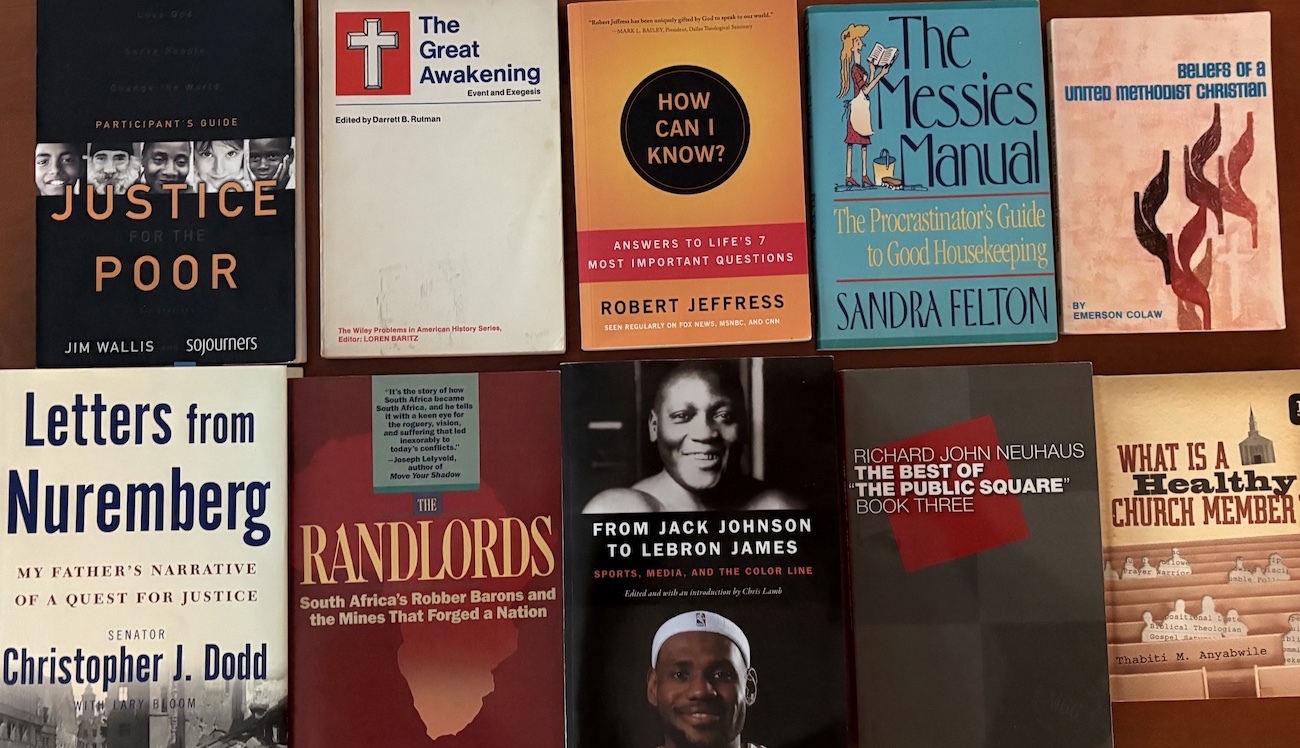
A Handful from ReStore
August 26, 2026
I love used book stores, including enterprises devoted to a much wider range of offerings, such as Goodwill and ReStore. I’ve found Goodwill everywhere. But, only since returning to Nashville have I come across Restore, a project of Habitat for Humanity. We have one up at Nolensville Rd and Harding Place, and another out on Columbia Pike, south of Franklin. Though small, their book sections can offer up treasures or small pleasures, as with this group I grabbed for a pittance the other day:
Letters from Nuremberg: My Father’s Narrative of a Quest for Justice, Christopher J. Dodd, with Larry Bloom (Crown, 2007).
Chris Dodd was the US senator who joined with Barney Frank to sponsor the Dodd-Frank Bill designed to address the factors leading to the Great Recession (2007-2010). His dad, Christopher Dodd, had also been a senator. But this was not his first high-visibility job. At the end of WWII, he served in the prosecution for the first Nazi war crimes trials (the medical trial held after he’d returned to the states). The outcome of Dodd’s trial was the hanging of a dozen, twenty-year sentences for two, and life imprisonment for four. This book assembles his correspondence home during those trials. It’s a rich collection, in which a marked a good many passages.
Zeppelin Field in Nuremberg, where Hitler held massive rallies, was renamed Soldiers Field just after the war, and, one day, 40,000 soldiers attended a double-header baseball game between Patton’s crew (71st Division, Third Army) and the 20th Division of the 7th Army. Dodd recounts, “I heard thousands of young American soldiers calling the umpire names” . . . heard players called “bums” and [heard] all the old chatter and ribaldry of every American ballpark.
He had nothing but contempt for the Russians, who’d also made it to Germany at the point of Hitler’s defeat: “I try to be fair in my thinking about them, but I have heard too much about them and the sight of them raises my blood. You have no idea of what goes on. They are beasts and worse. Believe me when I tell you these things for I have it from officers of unquestioned integrity who have seen with their own eyes. They are looting Germany of everything. When they occupy a town they proceed as follows: The first week all machinery and tools are moved out; the second week they strip every house of furnishings; the third week all men between 16 and 40 are shipped to Russia—and all the time rape and violence are the order of the day. . . .”
And there were fatherly instructions: “Do not pay Damien until he has painted the storm window two coats. Also cleaned up any mess he left.”
His November 9, 1945, letter begins, “Grace, my dearest one, Today is one of the most important days in the history of the world. It is the most important day in my own career. For this is the anniversary of the day you were born. What a difference if it had not happened. You have been on my mind very much—I love you so much, so completely. And it is wonderful to be married to you.” What a great expression of love and esteem.
His take on the defendants is interesting. He found some of them impressive and marveled that they would be so stupid as to follow Hitler. He even said some feared God. And he said what a shame it was that they wasted their powers on advancing evil when they could have done the nation great good. Then there was this word on Göring as he began to testify: “He is a charming rascal—a real buccaneer. He has said of himself, ‘I am out of the Renaissance’—and, indeed he is. One of his witnesses said he considered him the last great figure of the same period. He dominates this scene and he is far and away the dominating character in the dock.” Later, he remarks, “. . . He is a supreme egoist and a consummate liar . . . He is also a forceful talker and knows how to tell his story.”
In June of 1946, he had some harsh takes on some Supreme Court appointments back home: “The Justice [Jackson, the chief at Nuremberg] has told me that [Hugo] Black, the former Klansman, has not changed his bigoted mind, but to the public he makes it appear that he has. In the private sessions of the judges, he shows it. [Frank] Murphy is woman crazy and actually emotionally unstable to put it mildly. [The Wikipedia entry says that there were also rumors of homosexuality.] [William O.] Douglas is an opportunist—a trickster. Fine people for the highest court in the land.”
He also noted the brutal Russian formation of what would become the Warsaw Pact: “In Hungary, a recent election gave the communists 25 percent of the vote—but the freedom-loving Russians simply refused to permit the 75 percent majority to form the government. Romania, Bulgaria, Yugoslavia—all are in her clutch.”
And there’s a photo, with the caption: “Tom Dodd with the prosecution exhibit he had kept under a sheet: the shrunken head or a Polish prisoner, used by the commandant of Buchenwald as a paper-weight.”
When his part in the trial was over and before the sentencing, he took a quick tour up through Europe. He’d be home to his family in a few weeks. Turns out, he traveled in style: “I should tell you that I am traveling in a sixteen-cylinder Mercedes-Benz—it was Ribbentrop’s car—and needless to say it has everything but a bath! It is a convertible and we have had the top down most of the time.”
I also learned that, for a season, Clare Booth Luce flirted with Buddhism. And that the Nazi’s used the guillotine for many executions. This book is definitely a keeper.
The Randlords: South Africa’s Robber Barons and the Mines that Forged a Nation, by Geoffrey Wheatcroft (Touchstone/Simon & Schuster, 1985).
Through the years, I’ve been fascinated by things-South-Africa. In the movie, Gandhi, I saw the “colored” lawyer’s early days there, and in Breaker Morant and Young Winston, I got a look at the Boer War. A pastor friend, who’s preached there, told me that the fields above Cape Town reminded him of heaven, and I’ve used his extended description (with the reaction of his child in the back seat as they drove along) in sermons of my own. I have a friend who got a doctorate from there. I’ve mistakenly asked South Africans if they’re from Australia. I knew a Calvin College prof who lamented and wrote about apartheid and the role of Dutch Calvinists in its institution. And then there were the Mandela stories, including that of the film Invictus, starring Morgan Freeman and Matt Damon. It goes on and on and on. So, I couldn’t resist a look at this book.
I just had a little time to browse, so I didn’t mine this 300+-page book. I stuck mainly to the prologue, though I did turn back through it a bit. Interesting to get a fix on Cecil Rhodes of Rhodes Scholar fame. Reminded me of Alfred Nobel and the Nobel Prize. The former made it big in gold, the latter in dynamite. Neither was spiritually heroic, but recipients of those grants don’t typically get triggered and walk away from the reward.
It was good to learn the source of the word ‘Rand,’ as in “Randlords” and the South African currency, the Rand. The word is short for Witwatersrand (“white water ridge”), the geologic treasure house near Johannesburg, a formation yielding both gold and diamonds. This book tells the story of how a “poor and unknown country became rich, famous and powerful and all because of the mines.”
I was struck by some fascinating passages, such as these:
“White (or rather pinkish) men called themselves white and called black men black, sometimes. The universal word for the indigenous African peoples of the sub-continent was ‘Kaffir,’ in origin an Islamic word for an unbeliever, picked up by Europeans, and not a century ago as offensive as it has since come to be regarded.”
[In boom town Johannesburg in the late 1800s]: “When they were not drinking or whoring, many miners spent their time gambling. The men of Johannesburg would bet on anything: horses, prize fights, rat-killing dogs, cards, billiards, how many flies would land on a lump of sugar—and of course gold shares.”
[As Olive Schreiner, a South African, wrote] “Johannesburg at present has no politics. It is much too busy with material problems. It is hideous and detestable, luxury without order, sensual enjoyment without art, riches without refinement, display without dignity. Everything in fact which is most foreign to the principles alike of morality and taste by which decent life has been guided in every state of civilization. There was not a man there, she said, who knew a violin from a vegetable. Luxury without comfort.”
“The larger sea was the black population of the Transvaal, getting on for a million people: Pedi, Sotho, Tswana, who were conquered, visible but ignored, like the American Indians or the Irish peasantry in the eighteenth century.”
[Of “Randlord” Cecil Rhodes, whose will established the Rhodes Scholarships] “Rhodes was a solitary, uneasy youth. Then and later he was a lonely man, ‘fond of a glass or two’—his drinking was to be talked of—but who could ‘when jolly with the bottle talk like a Mirabeau. For the fair sex he cared nothing.’ He was often taken for a man older than his age, and struck those who did not know him as a queer fish, moody and silent until he suddenly spoke a ‘thought’ several times in a staccato voice. All his life he was more a striking than an attractive figure, with piercing eyes, high-pitched voice, and nervous, feminine laugh. He made few friends but those he made were devoted unless and until a breach came.” [Also, he traveled back and forth between South Africa and Oxford as he completed his degree intermittently.]
By the way, the Dutch were called “Boers” (“farmers”). The Dutch also founded New York City, and the garden district inland from the southern tip of Manhattan was called the “Bowery.” Also, the Dutch set up shop on the southern coast of Africa so that Dutch East India Company could replenish ships and crew by means of a “store house, granary, vegetable garden and hospital, and to buy what meat they could from the Hottentots, all for the sailors on their voyage to the Company’s rich eastern empire based in Java.”
From Jack Johnson to Lebron James: Sports, Media, and the Color Line, edited by Chris Lamb (U. of Nebraska, 2016)
This anthology by IUPUI journalism prof, Chris Lamb, has one purpose—to decry the absolutely/relatively poor press treatment of black athletes, vis-a-vis white athletes, and he has plenty of material to draw from. The anthology runs 600 pages, with 21 articles, addressing the media fortunes of boxing’s Jack Johnson, Joe Louis, and Muhamad Ali; track’s Jesse Owens, Tommy Smith, and John Carlos; football’s Kenny Washington, Michael Vick, and Donavan McNabb; baseball’s Jackie Robinson, Curt Flood, Barry Bonds, and Hank Aaron; Tennis’s Arthur Ashe; and basketball’s Michael Jordan and LeBron James. And some of the pieces speak more broadly, as on Sports Illustrated’s series on the “African American Athlete.”
Of course, it’s interesting and often embarrassing/appalling to see how various publications and personalities handled the emergence of black athletes. Still, this is an utterly tendentious book, essentially immune to feel-good reporting, and when the coverage was good, it’s typically explained in terms of the subject’s “good boy” or “right type” behavior, gratifying to whites. Nevertheless, it’s a good reference book, and inviting as a now-and-then read.
Not long into the book, I saw that the classic “dean of American sportswriters,” Grantland Rice garnered attention. He was originally a Vanderbilt man, perhaps most famous for characterizing the formidable, 1924 Notre Dame backfield as the “Four Housemen.” Until the college football playoff system was established in 2013, the Football Writers Association of America picked the national champion, awarding that team the Grantland Rice Trophy. (BTW, he was a poet as well as a sportswriter.) Among the cringy quotes is one from Rice, who once commented on Jesse Owens’s medal-winning performance at the Berlin Olympics as that of “a wild Zulu running amuck.”
Lamb doesn’t get around to covering the racialist-chip-on-the-shoulder commentary that has marked the careers of such black reporters as Jamelle Hill and Ryan Clark and much of the coverage sparked by the emergence of Caitlyn Clark and Sophie Cunningham in the WNBA. (For instance, Ryan questioned Heisman Trophy Award winner Robert Griffin III’s ability to address the attitudes of black WNBA players since he’d married a white woman.) Of course, Lamb would attribute their difficulties to just more prejudice. Of course, he would.
The Best of “The Public Square”: Book Three, by Richard John Neuhaus (Eerdmans, 2007).
When I saw this book on the shelf, I grabbed it immediately. Neuhaus has been an extraordinary writer, and I had the privilege participating in a conference he graced in Vienna. In 1984, he, as a Lutheran, penned The Naked Public Square, which warned of the perils of insisting that political and cultural discourse remain secular. Then, as a Catholic, he joined us in Vienna, where the discussion centered on the simultaneous death of the church in Europe and the spread of Islam on the continent. I’d become acquainted with his work through his writings in First Things, and, spying this volume made me both happy and sad—happy since it featured a couple of dozen pieces by him, sad because this was volume three in the series and I lacked the first two.
I’ve been working on a book contextualizing MLK’s “I Have a Dream” speech, so I turned first to an article about him, one that recounted Neuhaus’s meal with the civil rights leader along the way. In this piece, Neuhaus played off of a couple of books about MLK, one by Ralph Abernathy, another by Marshall Frady. The former devoted some space to King’s philandering, and Abernathy paid a price for addressing this sinful pattern. But Neuhaus didn’t gainsay the report. Yes, he had good things to say about MLK, but he was not as worshipful of the man as we’re supposed to be. Indeed, he noted the measure of sad decline in influence King was experiencing at the time of his death.
This was a good start on the book, and I’ll keep it handy on my bedside table for more reading. I took a quick look at the intriguing titles, and took a quick look at the one on evolution. Therein, I found Neuhaus treating creationists Behe and Dembski with respect, and calling macroevolution “preposterous.” Nice.
What Is a Healthy Church Member? by Thabiti M. Anyabwile (Crossway: 2008).
There was a day when Thabiti was an “answer to prayer” for conservative evangelicals. Despite his exotic name, the one he took when he, Ron Burns, converted to Islam during college in the early 90s, he’d converted to Christianity and shown himself theologically worthy of platform time at the likes of T4G and TGC. It seemed a bit odd that he would keep this Swahili/Arabic name (“upright” plus “freed by God”), but he held onto it for personal and cultural reasons.
His standing in 2008 is reflected in the personages who provided commendatory blurbs for this book, including MacArthur, Mohler, Carson, and Sproul. And he had pastoral staff service at Mark Dever’s Capitol Hill Baptist Church on his resume. But on into the 2010s, he went woke, and started saying such things as, regarding MLK, “My white neighbors and Christian brethren can start by at least saying their parents and grandparents and this country are complicit in murdering a man who only preached love and justice.” And he also came out for women pastors.
Still, in 2008, he provided some useful counsel in this little book. He coins the expression, ‘evangelical listening,’ that is “listening for the meaning of a passage of Scripture and accepting that meaning as the main idea to be grasped for our personal corporate lives as Christians.” He goes on to explain that it benefits us by “cultivating a hunger for God’s Word,” by “[helping] us to focus on God’s will and to follow him,” by “[protecting] the gospel and our lives from corruption,” by “[encouraging] faithful pastors, and by “[benefitting] the gathered congregation.” He also gives tips for “[ordering] your life around the gospel,” such as “intentionally frequenting the same stores (cleaners, restaurants, etc.) with the aim of building relationships and familiarity with store personnel, and hopefully having gospel conversations” and also “using vacations for short-term mission trips.”
On a sad note, he quotes Josh Harris favorably (as many of us did), unaware that Josh would abandon the faith in 2019, convinced that his new, liberal take on sexuality was incompatible with Christianity.
Beliefs of a United Methodist Christian, by Emerson Colaw (Tidings, 1972)
I see that this book was published in Nashville when I was in grad school at Vanderbilt. The UMC Board of Discipleship was also in Nashville, and, twenty-five years later, I worked in a city which hosted a couple of other UMC boards, Evanston, Illinois. Both schools, VU and NU, were of Methodist origin and had long since left their founders’ theological commitments behind. And, since 1972, the denomination itself has moved beyond the liberalism of the 70s, so much so that the new Global Methodist Church has provided of haven for Methodists who can’t abide the UMC’s drift any more.
Reading through this short book (132 pages) by a UMC pastor, later to become a bishop, and, at the time, a figure in conferences at the denomination’s highest levels, I see the seeds of destruction. In calm, cool words, he shows how UMC commitments (or lack of commitments) opened the door to the slippage that has left the denomination in disarray—this to the dismay of old acquaintance, Mark Tooley, a longtime Methodist and head of the Institute for Religion and Democracy. His group tracks the doctrinal fidelity of various denominations and encourages those who strive to keep them honest. For instance, he’s been an ally of the John Wesley Fellowship, publishers of Good News magazine.
Colaw trots out the standard “strength through diversity” line in his pluralism chapter, unaware that the diversity the UMC would parade in the next fifty years would manifest itself so absurdly and repellently that a bunch of Methodists had to bail. He could call what’s left “strong,” but that’s whistling in the graveyard.
I turned next to the chapter on the Bible and was not surprised to see dismissal of biblical inerrancy, a cause that Southern Baptists took up successfully. He trots out old, lame examples, such as the claim that Bible’s use of ‘sunrise’ misconstrues astronomy, and quotes Luther to say that the book of James was “strawy.” And he cites the work of their Theological Commission, which said,
The Bible is the deposit of a unique testimony of God’s self-disclosures: in the world’s creation, redemption and final fulfillment; in Jesus Christ as the incarnation of God’s Word; in the Holy Spirit’s constant activity in the dramas of history. It is the primitive source of the memories, images and hopes by which the Christian community came into existence and that still confirm and nourish its faith and understanding.
Hmm. Nice sounding, but only “a deposit of the unique testimony”? Well, Lord of the Rings is unique, as is The Shepherd of Hermas. And what else might one find in this unique deposit box? Is it all reliable? Apparently not, but their lights. Also, the Odyssey is a primitive source of images and such that helped shape a people. And, though a deposit of wisdom (e.g., “Avoid the Sirens’ song”), Homer’s work concatenates some strange images whose instructional value is amorphous (e.g., the boulder throwing Laestrygonians), and, if at all instructive, is just as well found elsewhere. So what’s so special about the Bible?
He goes on to reject “proof texting” and to assure us that Methodists are not literalists, nor are they people who think the Bible is error free in matters of science and history. (So, Scripture’s “unscientific” account of Lazarus’s return from the dead is doubtful?) He cites favorably the “demythologizing” work of Rudolph Bultmann, and goes on and on to anticipate unwittingly how a church proceeds when they abandon biblical inerrancy and sola scriptura and fly by the seat of their pants when it equates the authorities of the “Methodist quadrilateral”— Scripture, tradition, reason, and experience (as with the latter two, “I see no reason why I, a woman, should neglect my calling to be a pastor.”) Throughout, he peddles a caricature of the conservative Evangelical’s take on the Bible, as if, for instance, they didn’t know there were different scriptural genres.
So yeah, this UMC hotshot of the 1970s helped chart and advance the disintegration of his denomination by his declaration of where the “smart money” lay in theology and ecclesiology.
The Messies Manual: The Procrastinator’s Guide to Good Housekeeping, by Sandra Felton (Revell, 1984).
The last page of this points the reader to Messies Anonymous for more help. And, yes, I’ve been told that I need to pay more attention to this matter. For instance, our basement and garage hold (I’m told by a librarian) around 14,000 books. And then there are the files and stacks of stuff from the decades of my work life in church and academy. I maintain that these are treasures, something demonstrated piecemeal as these later years go by. But I respectfully keep my eyes open to counsel, such as this book provides.
From it, I’ll quote Felton’s Law: “Any Mess That Can Happen, Will.” And then there are “Rules of the House”:
If you open it________put it away
If you sleep in it______make it up
If you drink out of it___wash it
If you take it off______hang it up
If you turn it on______turn it off
If you drop it________pick it up
If you clip it_________file it
If it hurts___________comfort it
If it cries____________love it
How Can I Know? Answers to Life’s 7 Most important Questions, by Robert Jeffress (Worthy, 2012).
I’ve respected Robert Jeffress for his faithfulness to biblical inerrancy and his willingness to bring biblically-sensible commentary to the public square. When I saw this title, I thought that it would have a devotional cast to it, but, as it turns out, it’s good book of apologetics (says the former professor of apologetics at SBTS). It has good granularity, e.g., delineating different sorts of doubt—natural, philosophical, experiential, spiritual, and empirical.
And he shows that he doesn’t wilt when rebuffed for speaking the truth, however graciously. Back in 2011, he was in DC for the Values Voter Summit, and a reporter asked him if he believed Mormons were Christians. (Mitt Romney’s candidacy prompted this question.) Jeffress responded, “Mormons are good, moral people. Mormonism is not Christianity; it is a cult.” And then things exploded. CNN ran it as “breaking news” for the next seven hours. Interview requests poured in from the likes of the NYT, WAPO, Newsweek, and the cable networks, and he found himself talking on broadcasts with Chris Matthews and Bill Maher. Jeffress had been in Washington to introduce Rick Perry, and Romney demanded that Perry denounce the pastor for his judgment on Mormonism. Jeffress even got a mention in an SNL skit. But he held his ground, and then supplied an interesting distinction: He was speaking of Mormonism as a “theological cult” (with alternative scripture), not as a “sociological cult” (such as the Branch Davidians, with an outlandish take on the Bible). But still a cult, which it is.
BTW, the SBC Belief Bulletins issued by the Home Mission Board (pre-NAMB) distinguished between cults (such a Mormonism, Jehovah’s Witness, and Christian Science) and sects (such as Roman Catholicism and Seventh-Day Adventism).
In sum, it’s an academically serious book without being pedantic. It’s nice to see him quote friendly scholars (like C. S. Lewis and Peter Kreeft) and critics of orthodoxy (like Bart Ehrman and Harold Kushner). But he reserves generous space for edifying illustration and testimony, often tied to Scripture.
The Great Awakening: Event and Exegesis, ed. by Darrett B. Rutman (Wiley, 1970).
I’ve read a lot about awakenings around the world, from revivals in Wales to Shantung to Fulton Street in New York. I love these narratives and pray for a recurrence in America and abroad in our day. When I saw this title, I was hoping to be edified by what I read, but I recognized that it was a secular publisher who put this out in its “Problems in American History Series.” And it was 1970, when I started graduate school, a time when the proud decadence of the 60s was sloshing through academia. And the entry I read reflected this haughty take on Evangelicalism. I’ll grant that the book had inspiring selections, fitting for an anthology, but it included reflections (and, indeed, defamations) by historians, one by Vernon L. Parrington, whose “An Anachronism in the Age of Reason” worked hard at demeaning the work of Jonathan Edwards. Though Parrington’s influence has slipped since his death in 1929, in his day, he was all the rage in his take down of the Great Awakening. As Darrett Rutman, this book’s editor, put it in his introduction to Parrington’s essay, “ [he] reflected and propagated the almost classic view of the Awakening. Calvinism was dying —as it had to if democratic and liberal America was to come into being; Jonathan Edwards was the ‘reactionary Calvinist’ who attempted to revive the moribund; so, too, by implication, were the awakeners in general.” And it’s clear that Rutman is delighted to keep this take in play, a century after its publication. And not a word therein of the work of the Holy Spirit, or any sign of the biblical roots of Edwards’s theology.
Here's a brief selection from Parrington’s screed, one that, alas enjoys currency in academia:
“The five points of Calvinism, postulated on a God of wrath, were no longer living principles answering to common experience; they were become no other than ghosts that walked on the Sabbath to terrify the timid.”
He quotes Cotton Mather, from 1726, to note the Calvinist hegemony in the day: “I cannot learn, That among all the Pastors of Two Hundred Churches, there is one Arminian; much less an Arian, or a Gentilist.”
“In the corrupt worlds of Augustine and John Calvin such a doctrine must have seemed a reasonable explanation of the common brutality; an evil society must spring from the evil heart of man. But in the village world of New England the doctrine had lost its social sanction. When in moments of calm sense these provincial Calvinists asked themselves if the human heart were in truth utterly depraved, if they themselves and their neighbors were such vipers and worms as they professed to be, the conviction must’ve grown upon them that such professions were untrue. In short, these villagers knew that they were very far from a bad lot; and when they pondered on this fact, they must’ve discovered increasing difficulty in reconciling Sunday dogma and weekday experience.”
“As the century advanced, the growing dissatisfaction with Calvinism received fresh impetus from the new social philosophy of France . . . Such doctrines were fundamentally hostile to the spirit of Calvinism: not only did Rousseau set the doctrine of human perfectibility over against the dogma of total depravity, but he quickened the passion of revolt against every form of arbitrary authority, theological as well as political and social. Although the provincial colonial might not come in immediate contact with such speculative philosophy, in the long run he could not escape being influenced by it, and that influence with count against a decadent theology that held men’s minds in its tenacious rigor mortis.”
The terrors aroused by his [Edwards’s] minatory [i.e., threatening] sermons provided his clinical laboratory with numerous cases of abnormal emotionalism.
The repulsive records as they are set down in his Narrative of the Surprising Works of God, marked by evidenced of pathological states of mind not far removed from insanity, no longer seem a testimony to God’s beneficent presence; the spiritual writhings which this gentle-natured student watched with such fascination, appear rather to be cases for the alienist [doctor who treats mental illness] to prescribe for.”
“By a curious irony of fate, Jonathan Edwards, reactionary Calvinist and philosophical recluse, became the intellectual leader of the revolutionaries. His insistence upon conversion as the sole ground of admission to communion was the final blow that destroyed the old theocratic system which the Mathers had labored to uphold. Church and state were effectively cut asunder by such a test.”
Justice for the Poor/Jim Wallis & Sojourners: Participant’s Guide, by Rose Marie Berger and Jeannie Choi (Zondervan, 2010).
When I went to Wheaton to teach back in 1975, the college had us newcomers take a month-long course on the “integration of faith and learning.” At the end, a paper was due, and it wasn’t uncommon for those papers to turn into books. That’s what happened with me. I’d had a fellow graduate student at Vandy challenge my thinking on the topic of justice. He had a Mennonite background, and we found ourselves voting for different presidential candidates—he for McGovern, I for Nixon. He said he was voting that way since the Democrat was concerned with justice. I was pretty sure that the Republican cared about that too, but I hadn’t sorted out what I thought the concept covered. I knew it was big in the Bible, but I hadn’t done the spade work on the topic. So I took the Wheaton opportunity to address it, and A Christian View of Justice was the end product . . . and I think it still makes sense fifty years later.
I think I’ll work on an update, so I’ve been looking at other things that have been published in since I wrote the book. Jim Wallis is a familiar writer on the topic, so I thought I’d give this little book a look. And I wasn’t surprised to see the standard liberal takes on the topic. Repeatedly, I found myself offering rejoinders to their sweeping statements, e.g., when they study guide writers Rose Marie Berger and Jeannie Choi said, “Material poverty does not occur because one is spiritually poor,” I said, “Actually, much of it does, as Proverbs 24:33 teaches us”; and when they said, “Most Americans believe that if you work hard and full-time, you should not be poor,” I said, “Depends on what they’re working hard and full time at; if they knock themselves out hour by hour, day by day, chasing butterflies through the fields or painting abstract self-portraits, they’d do well to find a line of work which is so valuable to someone that they would pay them a living wage for their labors.”
But, no, we’re told, it’s the system, one sustained by the dolts who don’t see the social gospel as central to the gospel, people who are appalled at vast differences in wealth (the newbie behind the counter at McDonald’s compared to Elon Musk), those who blame the system for such horrors and who think America falls far short of decency despite having a standard of living the world envies. (Think, for instance, of the astonishment of Europeans who had the resources to make it to World Cup games in the US as they encountered the affordable bounty of Waffle House and Buc-ees, not to mention the Hondurans and Somalis who’d braved much to tap into our bounty.)
Oh, and there are food stamps, AFDC checks, Supplemental Security Income (SSI), thrift shops aplenty, a range of charities offering free support via food pantries, clothes closets, and such. There’s Habitat for Humanity, with their ReStore outlets and also Salvation Army care; free libraries and public schools for all kids; free clinics; school lunch programs; unemployment insurance; church networks that pick up and lodge street people on cold winter nights. And, yet, we should be ashamed of our country and ourselves for embracing a “tattered” gospel which neglects those in poverty (in the US, those below $16,000 for a single person per year, $33,000 for a family of four). And be sure that the answer is not for your church to gin up its caring ministry; that’s putting a band aid on cancer. Rather, it requires massive legislation, strangely resembling the Democrat Party platform. That’s the answer to the WWJD question.
Yes, the Bible has harsh words for those who close their hands to the poor, but serious Bible study looks at context, and, in this instance, asks whether Jerusalem and the other OT and NT regions had the social service network in place that our poor have at their disposal. Are they really as destitute (struggling to “exist”) as the ones we encounter (e.g., the widow and her mite) in Scripture? Yes, there are needy people in America, and there are scores of biblical admonitions to care for the poor, but to equate the situation in Bible times is odd, at least in the US, where the tax burden has increased exponentially, with much of the revenue going to social services. In the US in 1900, the “tax freedom day,” when the money you earned was yours, came on January 22; in 2026, it’s April 16.
Along the way, they do have some cool quotes, e.g., “As G. K. Chesterton said, ‘It may be possible to have a good debate over whether or not Jesus believed in fairies. It is a tantalizing question. Alas, it is impossible to have any sort of debate over whether or not Jesus believed that rich people were in big trouble—there is too much evidence and the subject and it is overwhelming.” Indeed, read Matthew 19:24 about a camel facing a needle’s eye.
BTW, Chesterton was Catholic, and so are many of those they quote. Nothing wrong with that, but just saying. The list includes Henri Nouwen, Francis of Assisi, Dorothy Day, Paulo Freire, Joan Chittister, Esther de Waal, E. J. Dionne, and Rose Marie Berger (one of the booklet’s writers). They’re representative of a huge Catholic, “social ethics” movement, which manifests itself in Latin America through “liberation theology,” a la Gutierrez and Romo. As pious as these folks may be, their church is not known for its “work ethic” and the prosperity that follows. Thus, Latinos swim the Rio Grande to gain access to the economic culture (marinated in capitalism) that Protestant-majority America provides.